



XERTHRA™ BMAC

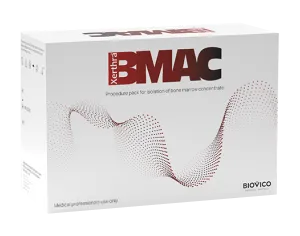
Xerthra™ BMAC is an innovative procedure set dedicated for the separation and concentration of bone marrow aspirate in order to obtain a concentrated bone marrow fraction (BMAC). Acquired BMAC is intended for local injection to improve the regenerative properties of cells and tissues by delivery of elevated number of stem cells and growth factors.
Xerthra™ BMAC procedure pack consists of highly efficient separation devices, that due to their unique design and construction material allows to separate and isolate the very high number of not only mesenchymal stem cells (MSCs) but also platelets (PLTs) in the final injectable product.
Xerthra™ BMAC can deliver BMAC with 5 times more concentrated MSCs and 4 time more concentrated PLTs1. Those parameters position Xerthra™ BMAC as one with the highest yield of cellular components which are key players in tissue regeneration. Consequently, mesenchymal stem cells, by differentiation into divergent type of cells, e.g. osteoblasts, chondrocytes will contribute to bone or cartilage reconstruction. On the other hand, platelets due to ability for delivery of different growth factors might control and initiate regeneration processes2,3,4.
Musculoskeletal tissue injury that changes the biomechanics will eventually induce prolonged tissue overload, and thus will not only lead to direct damage (wear and tear) but will also force to the negative shift in tissue homeostasis of leading to catabolic state of tissues like cartilage, synovium, meniscus or bone. Since catabolic state is strictly related to intensified production of tissue degradation enzymes, increased oxidative stress, enhanced inflammation, mentioned set of events will finally lead to elevated tissue damage1,2.
Biological therapies are a thriving therapeutic area of clinical management in variety of musculoskeletal diseases. For the past few years, platelet rich plasma - a blood-derived product rich in thrombocytes able to deliver high amount of growth factors, has emerged as one of the most prominent therapies in musculoskeletal disorders. However, latest interest in a field of a regenerative medicine shed light towards the assessment of biological therapy based on mesenchymal stem cells (MSCs) obtained from bone marrow aspirate in a concentrated form (BMAC). Its due to the fact that MSCs possess a differentiation potential towards, e.g.: chondrocytes, osteocytes and other cells delivering strong self-renewal and regeneration potential to joint tissues3,4. Beside the MSCs, another cell-form is present in the bone marrow – the platelets (PLTs) which are widely known as a significant source of a wide range of bioactive proteins with multiple biological functions, the growth factors. Due to this PLTs are able to greatly regulate musculoskeletal tissues homeostasis5,6.
Xerthra™ BMAC contains a highly efficient separation devices, which due to its unique design and construction allows to separate and isolate a very high number of the bone marrow cells in the final injectable product. BMAC separation device is made of Makrolon® polycarbonate that maximize the recovery rate of both cells and growth factors. This effect is provided due to a very low surface energy of Makrolon® polymer which prevents binding of the proteins and cells to the walls of the device, resulting in maximal number of MSCs in final injectable product.
As a result, the autologous product acquired by Xerthra™ BMAC separation device concentrates MSCs 5 times and PLTs 4 times more in compare to non-concentrated bone marrow aspirate (BMA)7. Specially designed procedure allows to obtain BMAC with 30% decreased concentration of the erythrocytes- cells not required for intra-articular injection. Moreover, in the final form after the preparation procedure, the product contains 2 times more concentrated growth factors, such as TGF-β or PDGF, than in BMA. On the other hand, ready to injection BMAC product does not contain most significant pro-inflammatory cytokines. Xerthra™ BMAC allows to obtain 2, 4 or 6 mL of highly concentrated bone marrow aspirate.
The main advantages of BMAC obtained by Xerthra™ BMAC is its safety as well as simple preparation and administration methods. Moreover, due to the product autologous characteristics, no unintentional immune response will be triggered after the injection and no donor-recipient disease transmission is possible8.
Package of Xerthra™ BMAC contains:
- BMAC separation device (3 pcs)
- Needle, 21G (1 pc)
- Needle 18G (1 pc)
- Single use syringe (with Luer-lock), 10 mL (4 pcs)
- Combi stopper, syringe cap (1 pc)
Recent clinical data show that BMAC administration can be clinically effective administered in knee osteoarthritis as a single intra-articular injection, what can bring up to 12 months clinical improvement4.
The product is meant to be used by medical practitioners only.
Bone marrow aspirate concentrate (BMAC) as a clinically effective solution for joint tissue treatment
Bone marrow can be entitled as a crucible of various cellular components, containing hematopoetic stem cells (HSCs), mesenchymal stem cells (MSCs) and platelets (PLTs). First mentioned cells are able to differentiate into blood cells family, while MSCs have the ability to differentiate into various of mesenchymal cells tissue, such as bone, cartilage, fat and muscles1.
Taking into account this capability of the MSCs, the researchers begin to consider the bone marrow aspirate (BMA) as a therapeutic agent with promising potential for joint tissue regeneration2. Nevertheless, the native BMA contains a significant amount of HSCs and fat tissue, while MSCs appears as 0.001% of all nucleated cells, thus attempt to concentrate cells seems to be a vital approach3. The acquiring procedure of concentrated bone marrow aspirate (BMAC) allows to increase not only the MSCs but also PLTs, which are a significant source of growth factors an inductors of many regeneration processes4,5.
MSCs are characterized with the reparative and trophic properties, which allows them to migrate towards the damaged tissue. Additionally, at the moment of activation, the MSCs can act as a immunosuppressive factor, balancing or inhibiting the immunologic cells6, but also together with PLTs they took part in production of factors responsible for reduction of cell apoptosis, fibrosis, and inflammation process7,8. The growth factors which are secreted by both cells are among many others including platelet derived growth factors (PDGF), transforming growth factor β1 (TGF- β1), insulin-like growth factor 1 (IGF-1), fibroblast growth factor 2 (FGF-2), hepatocyte growth factor (HGF) and vascular endothelial growth factor (VEGF)1,9.
It is well established that intra-articular injection of MSCs and PLTs in a form of BMAC product has shown that regeneration processes of the joint structures can occur10. Horie et al. described that MSCs implementation into the joint will increase the expression of collagen type II11. Growth factors secreted by the PLTs can positively affect the production and secretion of tissue extracellular matrix (ECM) components like ACAN, COL2A1, and HA. As this leads to induced biosynthesis of ECM components like aggrecan, type II collagen and hyaluronic acid, which will contribute significantly to increase of regeneration processes of articular cartilage12.
All of the mentioned effects makes the BMAC injections a highly recommendable therapy for a joint associated pathologies or injuries. Kim et al. (2014) described that BMAC injection significantly improved both knee pain and functions in the patients with degenerative arthritis of knee up to 12 months13. Additionally, in the study of Buda et al. (2013), the assessment of BMAC with collagen membrane was well tolerated in case of chondral lesions treatment. After three years of the study, the patients KOOS score improved by 52 points, the MRI showed an osteochondral regeneration of the lesion site and histology analysis pointed out that cartilaginous tissue contains predominantly type II collagen and proteoglycan-rich matrix14.